 Add to Chrome
 Add to Firefox
 Add to Edge
Learning View-Dependent Splatting Kernels
May 25, 2026
We present a differentiable framework to automatically learn view-dependent 2D kernels in a splatting-based pipeline to improve reconstruction quality and representation efficiency for novel 3D view synthesis. Our volumetric primitive is defined as a bounding ellipsoid and a 3D-kernel latent vector. We first learn a projection network to output a 2D-kernel latent, taking the attributes of the ellipsoid and the 3D-kernel latent as input. Next, the result is sent to a decoder to produce a radially symmetric 2D kernel in terms of Mahalanobis distance, bounded by the projected ellipsoid. The neural networks along with per-primitive attributes are jointly optimized. The effectiveness of our approach is demonstrated on standard benchmarks, comparing favorably against state-of-the-art techniques on both analytical and learned kernels. Finally, we extend the idea to learn general 2D kernels for 2D splatting as well as image representation.

Differentiable Adaptive 4D Structured Illumination for Joint Capture of Shape and Reflectance
May 07, 2026We present a differentiable framework to adaptively compute 4D illumination conditions with respect to an object, for efficient, high-quality simultaneous acquisition of its shape and reflectance, with a unified spatial-angular structured light and a single camera. Using a simple histogram-based pixel-level probability model for depth and reflectance, we differentiably link the next illumination condition(s) with a loss that encourages the reduction in depth uncertainty. As new structured illumination is cast, corresponding image measurements are used to update the uncertainty at each pixel. Finally, a fine-tuning-based approach reconstructs the depth map and reflectance parameter maps, by minimizing the differences between all physical measurements and their simulated counterparts. The effectiveness of our framework is demonstrated on physical objects with wide variations in shape and appearance. Our depth results compare favorably with state-of-the-art techniques, while our reflectance results are comparable when validated against photographs.
Learning Photometric Feature Transform for Free-form Object Scan
Aug 07, 2023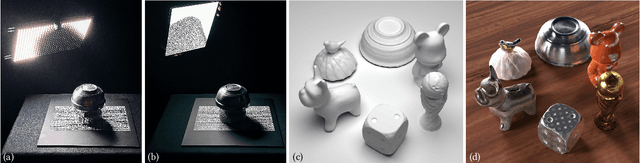
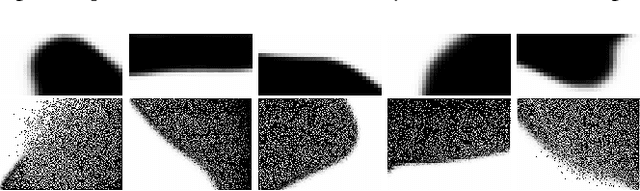
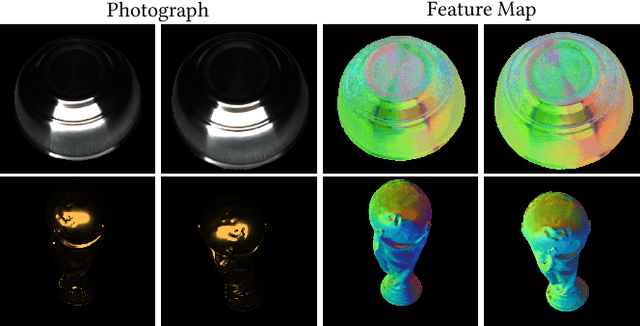
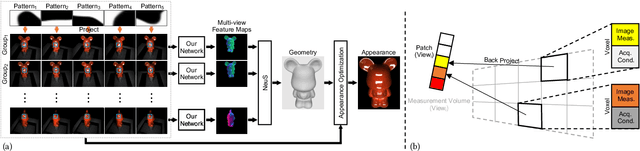
We propose a novel framework to automatically learn to aggregate and transform photometric measurements from multiple unstructured views into spatially distinctive and view-invariant low-level features, which are fed to a multi-view stereo method to enhance 3D reconstruction. The illumination conditions during acquisition and the feature transform are jointly trained on a large amount of synthetic data. We further build a system to reconstruct the geometry and anisotropic reflectance of a variety of challenging objects from hand-held scans. The effectiveness of the system is demonstrated with a lightweight prototype, consisting of a camera and an array of LEDs, as well as an off-the-shelf tablet. Our results are validated against reconstructions from a professional 3D scanner and photographs, and compare favorably with state-of-the-art techniques.